
Coaching connected learning across borders
I can support learning in online and blended course development (often through EU projects)
Project Partner
Varied experience with Nordplus, Erasmus+ and its predecessors
diversophy – intercultural game
Standard and refugee versions of the game for Denmark in the series
Free course package
Support refugees starting a business: course & facilitator training
Latest posts
-

Implementing Google Drive as a LMS
The Mastering 9 Conversations package of outputs is ready. One of the options we worked on was collating course materials in a set of Google Docs folders and I decided to test how that would work. The first step is to copy the bunch of folders and since Google Drive only lets you copy one item at…
-

Mastering 9 Conversations package available
It’s ready! If you want to help refugees in your local area who wish to start their own business as a way of supporting themselves and their family then the Mastering 9 Conversations package is ready. You have several options. We recommend that the 9 Conversations course is carried out face to face with a…
-

Chapter on Green Pedagogy available online
One of the most significant advantages of being a partner in the ProfESus project was learning about the Green Pedagogy approach to sustainability education. One of the originators of the Green Pedagogy approach, Christine Wogowitsch, and I have co-authored a chapter to bring the pedagogy to the English-speaking world from its Austrian origins and it…
-

diversophy® migrant-spil: Danmark
Guide til facilitering Formål I projektet “diversophy® migrant-spil – Danmark” har vi haft særligt fokus på at udvikle diversophy®dialog-spil til at skabe dialog og relationer i små danske landsbysamfund. Derfor har vi skabt nogle særlige processer omkring spillet, som beskrives her. Denne guide til facilitering skal ses som en udvidelse til diversophys®officielle Facilitation Guide. Hvor? Dette…
-
Embedding Google Sheet charts
Spoiler alert I haven’t managed it, at least not in the way I wanted. My best chance of success is now time. Eventually Google will realise that it must make embeds responsive. Why write this? As an aide-memoire to remind me what I have tried when I have to update the graphs in a years…
-
The continuing story of Mastering 9 Conversations
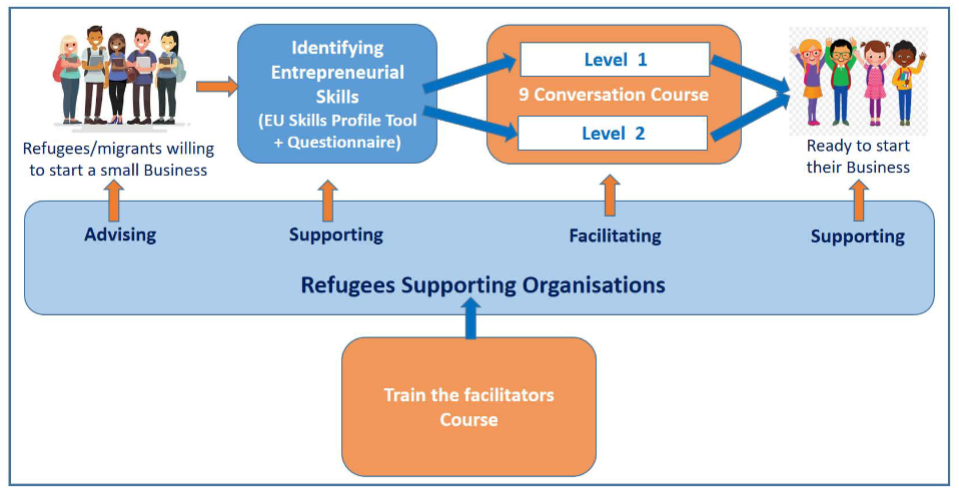
As a temporary employee of the Norwegian Unversity of Science and Technology (NTNU), part of my work involves contributing to the Erasmus+ Strategic Cooperation project Mastering 9 Conversations. We (9 Conversations) developed a programme to support refugees wanting to start their own business in their new host country and then we (Mastering 9 Conversations) developed…
-
Why networks matter
Extending your network lies at the heart of Linked In and yet the thought of it makes most of us cringe for various reasons. However, the evidence for the value of targeted networking is piling up and we are taking advantage of that in our Mastering 9 Conversations project supporting refugees who want to start…
-

Learning through discussion
In the original 9 Conversations project we developed a face to face program to support refugees wanting to start their own business in their new place of residence through nine meetings and the development of a relevant local network in between each session. The central dilemma was about how to balance imparting useful information with…
-

Discussion forums: where the teaching happens
in LearningDiscussion forums in online courses can easily be lifeless, dull and places where students simply fulfil the requirements of the task and nothing more. Flower Darby’s short webinar from November 2021 explains how the discussion forum can be where the teaching happens. Assuming the pre-requisites of a well-structured course in which learners feel safe to…
-

The 9 Conversations Toolkit
The challenge: How best to help refugees who want to set up their own business? This was the main aim of the 9 Conversations project which developed a programme that would be supported by a local facilitator and like-minded peers. The programme could also be followed individually by any refugee interested in starting a personal…
-

Pivoting online in a hurry
in PedagogyFinally! After all these years my online experience comes in handy. Though actually having to pivot online at a few days notice is nobody’s idea of the ideal circumstances in which to do so. And while I was happy to help, I can see that there is an overwhelming amount of material coming out to…
“Thanks a lot. I will suggest you as a teacher to my friends that will need to study English. You are really a good teacher!”
Federico
Physics student